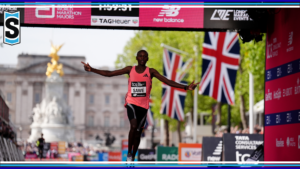
Sabastian Sawe’s exploit this April 26 at the London Marathon takes on a fascinating scientific dimension in light of the study published three days earlier by Professor Bert Blocken of Heriot-Watt University. This revolutionary research on aerodynamics in large groups of runners could well explain how the Kenyan broke the mythical 2-hour barrier in official conditions, achieving the impossible in 1h59’30.
Blocken’s work, the result of an international collaboration of thirteen institutions, demonstrates that runner training can reduce aerodynamic resistance by up to 90% and provide time savings of 20 to 30 seconds over a marathon. These figures, validated by cutting-edge digital simulations and wind tunnel tests, correspond exactly to the margin necessary to go under 2 hours from Kelvin Kiptum’s old record of 2:00:35.
Analysis of images from the London Marathon reveals that Sawe benefited from particularly dense training during the crucial phases of the race. The hares, positioned according to an optimized aerodynamic strategy, created the perfect conditions for exploiting the drag phenomena described by the research team. This scientific approach to drafting, already used during Kipchoge’s INEOS 1:59 Challenge in 2019, seems to have found its definitive validation in the streets of London.
The methodology developed by Blocken is based on computational fluid dynamics (CFD) simulations of unrivaled precision, using more than 57 million calculation cells to model the formations of 45 riders. Wind tunnel tests at the University of Liège, carried out with 3D printed models at a quarter of the real size, confirmed the numerical results. This double validation guarantees the reliability of the conclusions on potential aerodynamic gains.
A tactical revolution in progress
Sawe’s feat marks the entry of aerodynamics into the tactical arsenal of elite marathon runners. Blocken’s study reveals that even the lead rider benefits from a 25 to 30 percent drag reduction thanks to the subsonic disturbance effects created by the riders behind him. The finding challenges decades of traditional running strategies, where aerodynamics were considered negligible at the relatively modest marathon speeds.
The extension of the Woodside model, a reference since 1991 for predicting performance in long-distance running, constitutes another revolution in this research. By explicitly integrating the term aerodynamic resistance into the equations, the researchers created a predictive tool with formidable precision. This model reveals a quasi-linear relationship between drag reduction and time gain, validated by sprint data according to the Mureika model.
The study does not stop at group effects and explores neglected aspects: the impact of hairstyle and clothing. Tests reveal that certain hairstyles increase aerodynamic resistance by 8.7%, while clothing choice can account for more than 25% difference in drag. These discoveries open up new optimization perspectives that the running industry is already beginning to explore.
The industry quickly seized on these discoveries. OEMs are rethinking their approaches to product development, while coaches are integrating these concepts into their strategies. Sawe’s partner Adidas confirms having worked on aerodynamic optimization of the equipment used in London, without revealing technical details to preserve competitive advantage.
Sawe’s performance opens a new era where science catches up with high-level sport. The 1h59’30 in London is no longer an isolated feat but the result of a global scientific approach combining physiology, technology and aerodynamics. This methodological revolution could well redefine the limits of what is possible over 42.195 kilometers and inspire a new generation of world records.

AJ
PakarPBN
A Private Blog Network (PBN) is a collection of websites that are controlled by a single individual or organization and used primarily to build backlinks to a “money site” in order to influence its ranking in search engines such as Google. The core idea behind a PBN is based on the importance of backlinks in Google’s ranking algorithm. Since Google views backlinks as signals of authority and trust, some website owners attempt to artificially create these signals through a controlled network of sites.
In a typical PBN setup, the owner acquires expired or aged domains that already have existing authority, backlinks, and history. These domains are rebuilt with new content and hosted separately, often using different IP addresses, hosting providers, themes, and ownership details to make them appear unrelated. Within the content published on these sites, links are strategically placed that point to the main website the owner wants to rank higher. By doing this, the owner attempts to pass link equity (also known as “link juice”) from the PBN sites to the target website.
The purpose of a PBN is to give the impression that the target website is naturally earning links from multiple independent sources. If done effectively, this can temporarily improve keyword rankings, increase organic visibility, and drive more traffic from search results.
