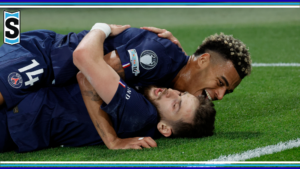
The match is described here and there as the match of the decade… PSG-Bayern, Tuesday evening, delighted and reassured football lovers. Frankly, the match was completely crazy, with a crazy pace from start to finish, actions in all directions, opportunities that followed one another and this impression that everything could change at any moment. But back to our analysis…
On the pitch, the Parisian club took a fragile but valuable option in its Champions League semi-final, winning 5-4 at the Parc des Princes at the end of a match whose offensive density immediately fed the European story. In front of the screens, the shock also had its effect: 2.85 million viewers on Canal+ Foot, the best audience of the season for the channel, ahead of PSG-Liverpool, which had 2.43 million viewers on April 8.
For Canal+, the evening ticked all the boxes for a premium program: a readable poster, two global sports brands, an immediately understandable issue, permanent dramaturgy and a volume of goals rarely achieved at this stage of the competition. According to RMC Sport, the meeting even reached a peak of 3.22 million viewers, with a 16.5% audience share, placing Canal+ Foot at the top of national prime time. HAS the scale of a pay channel, the signal is powerful. It confirms that the Champions League retains a rare capacity for aggregation, provided that the poster brings together spectacle, issue and incarnation.
This 5-4 is not only a spectacular result. It is an almost ideal television product, because it maintained the uncertainty until the end and transformed each sequence into an event. The economy of sports rights is based precisely on this promise: to offer live content that resists replay, content that is not just a video summary, a tension that the viewer wants to experience at the same moment as others. Tuesday evening, the Champions League recalled its central value in a fragmented market, where attention is increasingly difficult to gain. PSG-Bayern had the strength of major direct broadcasts: it created audiences because it created urgency.

The show as an audience lever
The figure of 2.85 million is all the more notable as it occurs on Canal+ Foot, in a paid environment. The performance clearly exceeds the previous season benchmark for the channel, established during PSG-Liverpool in early April. It is also part of a sequence where PSG’s European journey seems to once again become a driver of subscription, loyalty and conversation. For a broadcaster, this type of evening is not only measured in instantaneous volume. It nourishes the perception of value of the offer, justifies the premium positioning and reinforces the idea that certain competitions remain essential in a rights portfolio.
The comparison with the previous edition gives another scale. RMC Sport recalls that the PSG-Arsenal return match in 2025 brought together 3.4 million viewers on Canal+, for a total of 4.14 million watching the encrypted channel. The return to Munich, scheduled for next Wednesday at the Allianz Arena, therefore has considerable potential. The Parisian lead is short, Bayern has scored four away goals, and the scenario of the first leg has set up an almost mechanical wait. In terms of audiences, broadcasters know that a big first leg match is not only worth what it generates the same evening: it also builds the value of the following match.
For PSG, the scope also goes beyond the sporting result. A spectacular European semi-final, followed by nearly three million viewers on a pay channel, strengthens the club’s media power at a strategic moment of the season. The Parisian club is not content with being exposed; it is exhibited in a context of very high emotional intensity, where brands, partners and rights holders find the most value. The victory against Bayern associates PSG with a positive narrative: that of a team capable of beating a European giant by producing an offensive spectacle of international magnitude. For the image of a club, this association counts almost as much as the qualification itself.
Exceptional efficiency
The most striking dimension of the match is its offensive efficiency. Nine goals were scored on just 22 shots, representing an overall conversion rate of 40.1% of attempts, according to Opta data released by The Analyst. The previous record for goals in a Champions League semi-final was seven, which places the match in an exceptional statistical category. It is also the first time, in all European competitions, that two teams have each scored at least four goals in a semi-final.
This efficiency is all the more interesting as the expected goals tell a more nuanced story than the score. PSG generated 1.91 xG, compared to 2.51 for Bayern, again according to Opta (as a reminder, xG measures the quality of opportunities, not just the result, Editor’s note). In other words, Paris outperformed the average quality of its chances, while Munich also converted at a high level. This gap between expected production and actual production is precisely what shifted the match into another dimension. The poster was not only opened; it was of rare precision in the decisive zones.
For Bayern, conceding five goals in a European match is a historic event. The German club had not conceded five goals on the continental scene since the 1994-1995 season, during a Champions League semi-final second leg lost 5-2 against Ajax Amsterdam. For PSG, the offensive scale is part of a broader dynamic: the club has scored at least five goals in four different Champions League matches this season, equaling the benchmark established by Liverpool in 2017-2018 in the same campaign.
This data sheds light on the evolution of the PSG product. Long analyzed through the individual power of its stars, the Parisian club offers this season another form of sporting desirability: a team capable of generating volume, rhythm and controlled chaos. In a competition where media value relies as much on uncertainty as on the prestige of the posters, this profile is precious. PSG is not just selling a brand; it offers matches that can be watched, commented on and continued on social networks. Tuesday evening, this efficiency transformed a semi-final first leg into global content.
Canal+ Foot’s performance basically validates the logic of investment in premium rights. In a market where acquisition costs are high and where uses are dispersed between linear television, platforms, extracts and social conversations, major live broadcasts remain one of the rare formats capable of massively focusing attention. PSG-Bayern demonstrated this with particular force: the value of a right does not lie solely in the calendar or the nominal prestige of a competition, but in the capacity of a poster to produce an incontestable event.
The return to Munich thus becomes more than a decisive match for a place in the final. It’s a media event already established, driven by a spectacular first leg score, a tiny margin and a simple promise: Bayern must overthrow Paris, PSG must survive at the Allianz Arena. For Canal+, the sequence is ideal. For PSG, it is decisive. For the Champions League, it reminds us that at a time of audience fragmentation, major European football retains a rare privilege: that of transforming a Tuesday evening into a national event.
AJ
PakarPBN
A Private Blog Network (PBN) is a collection of websites that are controlled by a single individual or organization and used primarily to build backlinks to a “money site” in order to influence its ranking in search engines such as Google. The core idea behind a PBN is based on the importance of backlinks in Google’s ranking algorithm. Since Google views backlinks as signals of authority and trust, some website owners attempt to artificially create these signals through a controlled network of sites.
In a typical PBN setup, the owner acquires expired or aged domains that already have existing authority, backlinks, and history. These domains are rebuilt with new content and hosted separately, often using different IP addresses, hosting providers, themes, and ownership details to make them appear unrelated. Within the content published on these sites, links are strategically placed that point to the main website the owner wants to rank higher. By doing this, the owner attempts to pass link equity (also known as “link juice”) from the PBN sites to the target website.
The purpose of a PBN is to give the impression that the target website is naturally earning links from multiple independent sources. If done effectively, this can temporarily improve keyword rankings, increase organic visibility, and drive more traffic from search results.
