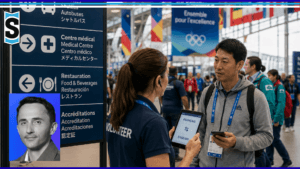
In this high-pressure international environment, the language barrier can become a factor of operational slowdown. Linguistic fluidity is therefore a strategic issue to guarantee the smooth running of competitions.
Complex mechanics under permanent tension
Global sports gatherings and major competitions mobilize players from dozens of countries, subject to sometimes very different regulations and security protocols. This diversity increases the level of coordination requirements.
A misunderstanding can have concrete consequences: a badge misinterpreted during an access control or a poorly translated security instruction can cause queues, chain delays or tensions with delegations and the media.
“Minute” logistics are particularly exposed, whether it involves changing training slots, adjusting shuttles or modifying schedules. A vague message can disorganize an entire team and impact the smooth running of the competition.
The anecdote from the 2018 PyeongChang Olympics, where a translation error transformed an order of 1,500 eggs into a delivery of 15,000, dramatically illustrating the risks associated with poor linguistic interpretation.
When language becomes a reputational issue
Beyond the organization, sporting highlights are global showcases. Each official statement or speech helps shape the perception of the event. Press services must adapt their messages without altering their meaning, while guaranteeing the alignment of messages across all markets.
This is where new solutions, such as voice translation, become essential. For international press conferences, for example, AI helps preserve the nuances of speech in real time, ensuring that the message from organizers and partners remains consistent, whatever the target language. An approximate translation not only generates misunderstanding: it can weaken a reputation or dilute the impact of a campaign.
Linguistic AI: a lever to streamline international coordination
Faced with the operational intensity of major events, linguistic AI stands out as a coordination accelerator. Instant written translation secures the circulation of instructions, whether they are emails, strategic documents (Word, PDF, presentations), or daily exchanges between teams.
In the field, oral communication is just as critical: last-minute technical briefings, safety briefings, or rapid arbitrations. In these moments when responsiveness is essential, advances in voice-to-voice translation make it possible to envisage smoother and more natural multilingual conversations, with ever lower latency. Some approaches aim for near real-time translation, while preserving the voice and intention of the speaker.
By combining written and oral translation, these technologies make it possible to maintain a high level of responsiveness and reliability. In competitions where every minute counts and where exposure is global, linguistic clarity stands out as a real factor in collective performance. It can no longer be thought of as a simple support tool, but as a structuring pillar of the organization, to be integrated from the event design phase to guarantee fluidity and success.
Ed Crook, VP Strategy and Operations at DeepL
PakarPBN
A Private Blog Network (PBN) is a collection of websites that are controlled by a single individual or organization and used primarily to build backlinks to a “money site” in order to influence its ranking in search engines such as Google. The core idea behind a PBN is based on the importance of backlinks in Google’s ranking algorithm. Since Google views backlinks as signals of authority and trust, some website owners attempt to artificially create these signals through a controlled network of sites.
In a typical PBN setup, the owner acquires expired or aged domains that already have existing authority, backlinks, and history. These domains are rebuilt with new content and hosted separately, often using different IP addresses, hosting providers, themes, and ownership details to make them appear unrelated. Within the content published on these sites, links are strategically placed that point to the main website the owner wants to rank higher. By doing this, the owner attempts to pass link equity (also known as “link juice”) from the PBN sites to the target website.
The purpose of a PBN is to give the impression that the target website is naturally earning links from multiple independent sources. If done effectively, this can temporarily improve keyword rankings, increase organic visibility, and drive more traffic from search results.
