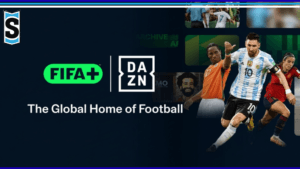
FIFA+ already existed as a proprietary environment, but its capacity to emerge in the face of the fragmentation of uses and the inflation of video offerings remained limited. By switching its service to DAZN, FIFA is choosing the logic of critical mass. It relies on a platform already established in more than 200 markets, equipped with an infrastructure designed for direct, advanced personalization tools and a marketing impact much greater than that of a service published alone. “This is a significant shift in the value chain: the world federation is no longer content with producing and aggregating content, it is looking for a partner capable of accelerating its distribution, engagement and, ultimately, monetization,” explains FIFA.
One platform, two ambitions
The message from both parties is simple: to build a unique destination to experience football all year round. Behind this promise, we must read a very clear convergence of interests. FIFA provides a unique global inventory, nourished by its competitions, its archives and especially the content of its member associations, long dispersed or barely visible outside their domestic markets. DAZN, for its part, brings to the table its technology, its user base, its editorial know-how and an already dense portfolio of premium rights, from European football to other major international disciplines. The integration of FIFA+ allows it to further expand its offering without being limited to the logic of major championships: the platform adds depth, internationality and volume, with a promise of free content likely to broaden the acquisition funnel.
The figure of nearly 8,500 live events per year gives the measure of the project. It is not just a question of installing a FIFA corner on DAZN, but of transforming an institutional heritage into a continuous flow.
Member associations will therefore be able to benefit from global exposure that they often struggle to obtain on their own, particularly for their youth selections, their women’s competitions or off-the-radar meetings of the major broadcasters.
By giving visibility to its 211 associations via a global platform, FIFA is strengthening its narrative of universality while creating a digital asset that is much more readable for commercial partners.
The offer announced for 2026 goes in this direction. It notably includes the U-20 Women’s World Cup in Poland, the U-17 Women’s World Cup in Morocco, the U-17 World Cup in Qatar and, in certain territories, the FIFA Intercontinental Cup.
Added to this is a whole range of premium recycling work from the archives: full matches, summaries, goals, compilations and editorialized formats from major past competitions, first and foremost the Men’s World Cup and the Women’s World Cup. This is a classic lever for platforms, but particularly powerful in the case of FIFA, which has one of the richest video assets in world sport.
FIFA seeks scale, DAZN centrality
For several years, DAZN has been pursuing a consolidation strategy aimed at becoming less of a broadcaster among others than a global aggregator of sporting experiences. The group highlights more than 140,000 live events broadcast each year, a presence in more than 200 markets and a technical architecture designed for low-latency sports streaming. In this logic, FIFA+ is not a simple addition to the catalog: it is one more brick in the construction of a global stronghold, where users watch, interact, play and consume in the same environment.
And DAZN not only collects content, but also the technical, editorial, distributive and commercial responsibility for FIFA+. In other words, FIFA agrees to close its existing service to switch its users into the DAZN ecosystem, with a transition organized around the identifiers of the two platforms. It is a heavy decision, which reflects a clear trade-off between technological sovereignty and market power. FIFA retains political control and the value of its brand, but now entrusts execution to an actor who knows how to industrialize distribution on a global scale.
The precedent of the 2025 Club World Cup had already served as a laboratory. The operation showed the common interest of the two groups in bringing together a holder of global properties and a platform seeking centrality. With FIFA+, the relationship changes in nature. We are moving from event-based collaboration to a logic of permanent advice, nourished all year round and designed to capture data, retain audiences and create new commercial opportunities. The interactive functions announced, notably via FanZone, go in this direction: live discussions, quizzes, surveys, games and player speeches contribute to transforming viewing into a community experience.
There remains a fundamental question, essential for the market: to what extent can this model redefine the hierarchy of football distribution? By aggregating premium rights, institutional competitions, archives and engagement tools, DAZN is clearly seeking to move away from the classic prize war to establish itself as an access layer to sport. FIFA sees it as a way to finally give an industrial scale to FIFA+, whose initial promise was strong but whose scope remained incomplete. If the execution follows, this launch could weigh well beyond its sole inventory: it outlines a form of unprecedented rapprochement between a global rights holder and a platform which no longer only wants to broadcast football, but to organize it around itself.
AJ
PakarPBN
A Private Blog Network (PBN) is a collection of websites that are controlled by a single individual or organization and used primarily to build backlinks to a “money site” in order to influence its ranking in search engines such as Google. The core idea behind a PBN is based on the importance of backlinks in Google’s ranking algorithm. Since Google views backlinks as signals of authority and trust, some website owners attempt to artificially create these signals through a controlled network of sites.
In a typical PBN setup, the owner acquires expired or aged domains that already have existing authority, backlinks, and history. These domains are rebuilt with new content and hosted separately, often using different IP addresses, hosting providers, themes, and ownership details to make them appear unrelated. Within the content published on these sites, links are strategically placed that point to the main website the owner wants to rank higher. By doing this, the owner attempts to pass link equity (also known as “link juice”) from the PBN sites to the target website.
The purpose of a PBN is to give the impression that the target website is naturally earning links from multiple independent sources. If done effectively, this can temporarily improve keyword rankings, increase organic visibility, and drive more traffic from search results.
