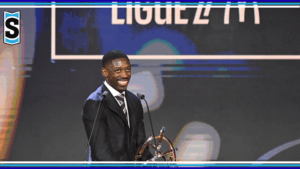
The best symbol of this trend is Ousmane Dembélé. Crowned best player in Ligue 1 for the second year in a row, the PSG winger has only played twenty league matches this season, including only nine starts. With 10 goals and 6 assists, his effectiveness remains real, but his reduced playing time inevitably fuels the debate.
In a football obsessed with KPIs, expected goals and advanced performance models, the vote of players and coaches favored something else: the impact left on the pitch and in minds. Didier Deschamps summed it up during the ceremony: “Beyond being an artist, you are a good inspiration for the younger generations. » Dembélé doesn’t win just for his stats. He wins for what he represents. The dribbling, the unpredictability, the spectacle. A perfect embodiment of the attacking and entertaining football that PSG are looking to export ahead of their Champions League final against Arsenal.

Because these UNFP Trophies now go beyond the national framework. A few days before a major European final, the ceremony also acts as an international showcase for Ligue 1. The distinctions won by Dembélé or Désiré Doué contribute to the story of a championship capable of producing global stars and bankable players. This logic is not necessarily illegitimate. The UNFP Trophies remain above all a human vote, designed to reward the imprint left on those involved in the championship, and not just an accumulation of data.
But certain choices nevertheless fueled discussions. The absence of Esteban Lepaul in the eleven type is the best example of this. Recruited for 13.5 million euros from Angers last summer, the Rennes striker finished top scorer in the championship with 20 goals in 33 matches. A regularity which, however, was not enough to convince voters. In reaction, Stade Rennais published a meme of LeBron James accompanied by a referee to point out this absence deemed incomprehensible. Conversely, Mason Greenwood is in the eleven for the season despite a more irregular campaign. Today, these distinctions are no longer just symbolic. They directly participate in the development of a player on the international market.
A ceremony thought of as a story
This 2026 edition also confirmed another trend, the UNFP Trophies reward stories as much as performances. The most notable moment of the evening did not concern a goal or a ranking. It came from Tahirys Dos Santos. Seriously burned during the Crans-Montana fire, the 19-year-old player took the stage with his partner Coline to present the best player trophy to Melchie Dumornay. “Today, things are better,” he simply confided in front of a silent Palais Brongniart. The sequence had a profound impact on the ceremony. It also illustrates the way in which French football now seeks to humanize its players and put emotion at the center of its story.

The coronation of Pierre Sage is part of this same logic. Arriving in Lens after his time in Lyon, the French technician transformed the northern club into a credible runner-up to PSG and future qualifier for the Champions League. His victory against Luis Enrique tells more than just a simple sporting choice. It opposes two models, that of the international star coach, embodied by the Spanish coach of PSG, and that of the French builder capable of advancing a collective with more limited means. Implicitly, the vote of French football players also promotes a certain local know-how. In a championship where the big clubs are banking more and more on prestigious foreign profiles, the coronation of Pierre Sage looks like a recognition of the model of the French coach trainer and developer. Even the absence of Luis Enrique feeds this story. Staying at home to “study Arsenal”, the Parisian coach despite himself reinforced his image as an obsessive technician, totally focused on performance.
Referees, new faces to protect
In French football regularly shaken by refereeing controversies, the highlighting of Jérôme Brisard and Huseyin Ocak is also a communication strategy.
Refereeing remains one of the most exposed functions in professional football. By publicly promoting its referees during such a high-profile ceremony, the League is trying to give a human face to a profession that is regularly targeted. The case of Huseyin Ocak perfectly illustrates this desire. Rewarded after several major posters this season, the French assistant becomes one of the positive symbols of arbitration often reduced to weekend controversies.
The revolt of the forgotten
But this 2026 edition also left frustrations. And the reactions of the clubs show that these trophies have become much more than a simple honorary reward. SCO Angers strongly contested the absence of Hervé Koffi from the best goalkeeper trophy. The club recalled several strong statistics: highest number of saves in the championship, best save percentage, highest rate of goals avoided and ten clean sheets. Figures which reinforce the debate around the choice of Robin Risser, also author of an impressive season with Lens and his eleven clean sheets.

This opposition perfectly illustrates the current divide in modern football. On the one hand, the collective perception and emotional impact. On the other, statistical models increasingly used in recruitment and performance analysis. Because today, a presence in a typical eleven or an individual trophy can increase the market value of a player with European recruiters.
This edition could thus relaunch a debate already present in several European championships: should we integrate more statistical criteria into the voting method? For the moment, the UNFP Trophies are essentially based on the vote of players, coaches and players in professional football. A method which retains strong human legitimacy, but which also exposes the ceremony to criticism around prestige, popularity or “star-power”.
At a time when European clubs are relying more and more on data to manage their recruitment, a hybrid model combining human voting and performance indicators could gradually emerge. Because modern football is now moving forward with two realities: that of the emotions that make supporters vibrate, and that of the figures that have become essential in the economy of sport.
A still powerful showcase for Ligue 1
Despite the debates, the UNFP Trophies remain a particularly effective public relations operation for French football. PSG further consolidates its image as a spectacle club with the distinctions of Ousmane Dembélé and Désiré Doué. Lens confirms its rise in power with Robin Risser and Pierre Sage. And Michael Olise, rewarded after his season at Bayern Munich, recalls the ability of French football to export its talents to the biggest European stages.
The typical eleven also tells another reality, that of an increasingly polarized championship. Between PSG and Lens, nine out of eleven players make up this ideal team. A domination which reflects both sporting differences and visibility differences. Basically, this 2026 edition confirms an evolution of modern football, the trophies no longer reward only performances, but also an image, an emotion and an ability to make an impression. In modern football, data measures performance. The trophies still reward those who make an impression.
Yvana Grumiaux
PakarPBN
A Private Blog Network (PBN) is a collection of websites that are controlled by a single individual or organization and used primarily to build backlinks to a “money site” in order to influence its ranking in search engines such as Google. The core idea behind a PBN is based on the importance of backlinks in Google’s ranking algorithm. Since Google views backlinks as signals of authority and trust, some website owners attempt to artificially create these signals through a controlled network of sites.
In a typical PBN setup, the owner acquires expired or aged domains that already have existing authority, backlinks, and history. These domains are rebuilt with new content and hosted separately, often using different IP addresses, hosting providers, themes, and ownership details to make them appear unrelated. Within the content published on these sites, links are strategically placed that point to the main website the owner wants to rank higher. By doing this, the owner attempts to pass link equity (also known as “link juice”) from the PBN sites to the target website.
The purpose of a PBN is to give the impression that the target website is naturally earning links from multiple independent sources. If done effectively, this can temporarily improve keyword rankings, increase organic visibility, and drive more traffic from search results.
