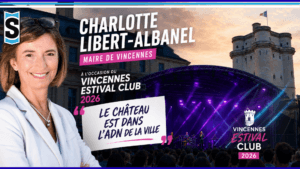
Pour Charlotte Libert-Albanelmayor of Vincennes since 2017 and elected official of the city since 2001, the issue goes far beyond the programming of a festival. It touches on the very identity of Vincennes. “I know Vincennes well,” she smiles, recalling that she arrived there at the age of one. The castle is “in the city’s DNA”. But this DNA remained partly confiscated for a long time. A military site, property of the army, operated with the Ministry of Culture for the keep and the Sainte-Chapelle, the castle has had a history of thwarted access. “When I was young, he was open to everyone. We came to walk there,” remembers the mayor. Then Vigipirate tightened the entry conditions, gradually moving some of the Vincennes residents away from a monument that was familiar to them.
This is where sports come into play. Not as a simple event pretext, but as a formidable lever of appropriation. At the time of the Paris 2024 Olympic Games, Charlotte Libert-Albanel suggests that the castle host a fan zone. “I knew that the theme of the Games was heritage with the Games,” she explains. The intuition is strong, almost obvious: to bring together sporting emotion and the symbolic power of a historic site. The result exceeds expectations. For fifteen days, 160,000 people pass through the castle. The monument ceases to be a silhouette in the background; it once again becomes a place of life.

“We said to ourselves: it is not possible to close this castle in the summer,” continues the mayor. From this evidence was born the Vincennes Estival Club, designed as an annual meeting. The 2026 edition is held from July 10 to August 2with a clear principle: to make the Château de Vincennes “the unmissable spot of your summer”, between sporting activities, concerts, screenings, live broadcasts, food corner and festive evenings. Access to the site is free, except Friday and Saturday evenings from 6 p.m., when popular pricing is provided.
The intelligence of the project lies in its balance. During the day, the castle becomes a large open-air club, geared towards practice, discovery and physical activity, particularly for young people who don’t always go on vacation. In the evening, it changes light and register: concerts, cinema, comedy club, sports broadcasts. “The sports part during the day, and in the evening we transform the castle a bit into a rather cultural operation,” summarizes Charlotte Libert-Albanel. The festival thus rests on “two feet”: sport and culture. Two worlds which often coexist without meeting, and which Vincennes strives here to bring into dialogue. “This culture-sport mix is quite interesting because these are not necessarily audiences who usually meet. »
This ability to create unexpected crossovers is original and inspiring. We come for a match, we stay for a concert. We accompany our children to a sporting activity, we discover the castle courtyard in a different way. We cross eastern Paris for an evening, we leave with the impression of having lived an experience that resembles neither a classic festival nor a simple municipal event. In one week, the event has already attracted more than 40,000 visitorsproof that the promise finds its audience. “A priori successful bet,” slips the mayor.
The gauge imposes its own discipline. The site generally welcomes 3,000 people per evening, with possible exceptions, such as during a World Cup broadcast increased to 4,000 spectators with the authorization of the prefect. “We hope to be able to vary the gauge a little bit to increase to 4,000 per evening, which is already a lot for a site like this,” specifies Charlotte Libert-Albanel. This constraint, far from restricting the project, also gives it its singularity: the Vincennes Estival Club remains an event on a human scale, spectacular without falling into excess.
The musical programming illustrates this desire for diversity. The mayor cites Youssoupha, a K-pop concert aimed at teenagers, Keziah Jones, Les Innocents. She insists on this choice of “varying the range of artists”, in order to reach different audiences. In this dynamic, the concert of Synapson, scheduled for July 28is one of the expected highlights: an evening designed to make the stones of the castle vibrate, between solar electro, pop elegance and the promise of a great summer gathering.
 350 events per year
In Vincennes, this ambition does not fall from the sky. It is based on a dense local tissue. The city welcomes more than 350 events per year, of all kinds: sporting, cultural, social. “We are lucky to have a lot of associations that support these events,” underlines Charlotte Libert-Albanel. The Festival America, the Foulées de Vincennes, the meetings carried out by volunteers: all of this creates a favorable environment. “We are really lucky: people build the city’s entertainment themselves. » The Vincennes Estival Club is supported by the City, with an assumed financial effort. The first edition still benefited from funding linked to the legacy of the Games. The current edition is essentially based on the community, with help from the Paris Est Marne & Bois region.
But the Olympic legacy, precisely, is not limited to a budget line. It is measured by the capacity of a territory to transform a parenthesis into a trajectory. “The bottom line is also to say that this castle deserves to be much better known,” insists the mayor. A “fundamental heritage in the history of France”, it remains, according to her, too little visited in view of its importance. Since the Games, the attendance curve has been “clearly increasing”, including international visitors. The initial objective was to bring back the Vincennois. Then the Ile-de-France residents. From now on, the issue becomes tourism.
And the project takes on a strategic dimension for eastern Paris. Charlotte Libert-Albanel rightly points out: the center of Paris is today saturated. Vincennes offers another way of experiencing the capital destination: a day that begins at the castle, extends into the woods, passes through the Floral Park or the zoo, and can stretch to the banks of the Marne. “When you want to extend your stay by one or two days, you have to offer alternative things,” analyzes Charlotte Libert-Albanel. “The fact of being able to come to the castle, then go into the woods, see the Marne, is clearly something that can occupy a day. » The castle then becomes “the gateway to this territory”.
An action plan to transform eastern Paris
The mayor sees even further: eastern Paris as a natural link in a tourist route between Paris and Marne-la-Vallée. “We must not forget that we are on the road to Disney. Spending a day or two in eastern Paris now makes sense for a tour operator. » In this reading, the Vincennes Estival Club is not only a local party; it is a tool for territorial attractiveness, a bridge between heritage, sport, culture and experiential tourism.
The rest is also written in the equipment. Vincennes is renovating its performance hall, which will increase from 500 to 700 seats, with expanded stage possibilities. “We were limited both in the volume and in the type of shows,” explains the mayor. Tomorrow, the city will be able to host more dance, theater, circus and standing concerts. A coherent rise in power for a “culturally active” municipality of 50,000 inhabitants. On the sports side, the Isabelle-Autissier room is now open and will host competitions. “Within two years, we will have everything working. There, we will have an action plan. »
This action plan demonstrates the new grammar of attractive cities. It is no longer enough to pile up events or have remarkable heritage. We must create uses, create stories, open places, hybridize audiences. In Vincennes, the fortress becomes a club, the club becomes a festival, the festival becomes a strategy. And in the courtyard of the castle, between a balloon, a giant screen, a stage and a crowd looking up towards the ramparts, a city seems to have found the best way to tell the story of its summer: by inviting everyone to enter. Quite simply.
Alain Jouve
PakarPBN
A Private Blog Network (PBN) is a collection of websites that are controlled by a single individual or organization and used primarily to build backlinks to a “money site” in order to influence its ranking in search engines such as Google. The core idea behind a PBN is based on the importance of backlinks in Google’s ranking algorithm. Since Google views backlinks as signals of authority and trust, some website owners attempt to artificially create these signals through a controlled network of sites.
In a typical PBN setup, the owner acquires expired or aged domains that already have existing authority, backlinks, and history. These domains are rebuilt with new content and hosted separately, often using different IP addresses, hosting providers, themes, and ownership details to make them appear unrelated. Within the content published on these sites, links are strategically placed that point to the main website the owner wants to rank higher. By doing this, the owner attempts to pass link equity (also known as “link juice”) from the PBN sites to the target website.
The purpose of a PBN is to give the impression that the target website is naturally earning links from multiple independent sources. If done effectively, this can temporarily improve keyword rankings, increase organic visibility, and drive more traffic from search results.
